
Chinese students remain the largest international student cohort in Australia, and they continue to provide the lion’s share of revenue for Australian universities.
But experts have warned that could soon change.
In February, Department of Home Affairs data confirmed forecasts that Chinese student numbers to Australia have been declining.
It showed there was a 25 per cent drop in the number of student applications over the first half of the 2025-26 financial year following a 12 per cent decline over the 2024-25 financial year.
The data came after a report from Moody’s Ratings in January predicted Chinese student numbers in Australia would take “sharp turn for the worse” after 2030.
Experts say there are many factors driving this trend.
‘People more selective’ amid uncertainty
Grace Li, a law faculty associate dean at the University of Technology, Sydney, also looks after Chinese international student recruitment for the law faculty.
She said one factor was China’s uncertain domestic economy.
Grace Li said Australian degrees were no longer a “golden ticket” to a good job. (Supplied)
“People are more selective and more sensitive in making a major financial decision in terms of sending their child to study abroad,” she said.
Melbourne-based migration and education agent Sean Dong said studying in Australia could cost about $50,000 to $60,000 a year.
Combined with rising living expenses, he said it was “a significant investment”.

Sean Dong said it was a “significant investment” for international students to study in Australia. (ABC News: Lachlan Bennett)
Professor Li said Australia’s skyrocketing Temporary Graduate visa application fee — which recently doubled — could soon be another factor.
Student numbers are also predicted to decline further with China’s falling birth rate.
“What we’re seeing is demographic decline … which poses risks to long-term demand [for Australian universities],” said Moody’s analyst Matthew Circosta.
The agency said Australian universities should look at pivoting away from the Chinese market.
China’s plunging birth rate combined with its aging population have also fuelled predictions of a long-term decline in the country’s economic growth.
As of October 2025, there were 192,225 Chinese international students in Australia, accounting for 23 per cent of the total 833,041 international students, according to Department of Education data.
More students studying closer to home

The “halo effect” of an overseas degree has vanished in the eyes of many Chinese employers, experts say. (Unsplash: Element5 Digital)
Professor Li said an Australian university degree was once seen as “golden ticket” to a good job, but that was no longer the case.
A tightening domestic labour market also means jobs could be harder to get.
Official figures showed the youth unemployment rate in China had been steadily increasing from 10 per cent in 2018 to a peak of 21.3 per cent in 2023.
While it has since eased, it remains relatively high at 16.3 per cent.
In China, overseas graduates are also no longer guaranteed high-paying jobs, and the “halo effect” of an overseas degree has vanished in the eyes of many Chinese employers, experts say.
Chinese students are not just turning away from Australia, but also from the United States and Canada, according to a report from the Institute of International Education released in November.

Natalia Tan said many of her peers were now opting for universities in Asia. (Supplied: Natalia Tan)
Meanwhile, a 2025 report from consultancy group HighMark Group in China found more Chinese students are choosing universities in Asia.
Natalia Tan, who chose to study law at China’s Peking University in 2019, said tuition fees in Australia were already expensive when she had been considering her options.
Ms Tan said many of her peers were now opting for universities in Singapore, Hong Kong, Japan or South Korea.
She said the customs and culture were more familiar in those countries, so “it was easier to adapt”.
Peking University’s juris doctor program also ranked higher than Australian universities’ programs, she added.
Australian universities are expanding overseas. (Supplied: Pexels.com)
Since 2019, the number of Chinese universities in the world’s top 100 has surged, according to major rankings.
Top universities in China, including Tsinghua, Peking University and Fudan have all improved significantly.
Moody’s analyst Mr Circosta said the rise in the competitiveness of Chinese institutions would likely continue to reduce demand for overseas education.
Studying in Australia encourages ‘open-mindedness’

Iris Yu is studying law in Sydney. (Supplied: Iris Yu)
Chinese students already in Australia say there are benefits to studying here.
Iris Yu is set to complete her bachelor’s degree in law at the end of this year.
“The main purpose of studying in Australia was that I wanted to go out and see the world, to experience it for myself,” Ms Yu said.
“Sydney is quite international, and I have made friends from all over the world.”
For Ms Yu, three years in Australia have provided a lesson in “open-mindedness”— a quality she believes is a “deep-level” takeaway that can only be gained through immersion.
“These are things that can only be truly experienced after living abroad, especially in Australia, for a period of time.”
How Australian universities are responding
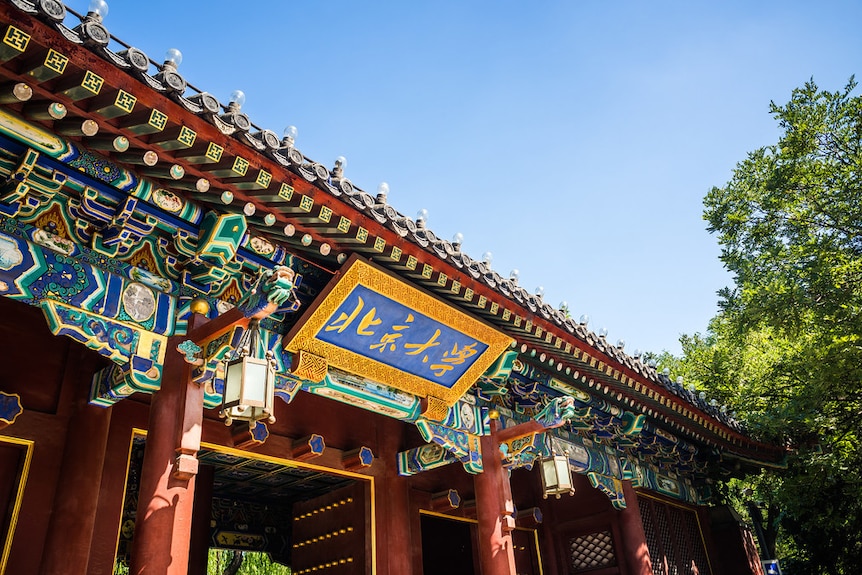
More Chinese universities are ranking among the top universities in the world. (Supplied)
In response to questions about the Moody Rating’s forecast, Universities Australia chief executive Luke Sheehy said international education in Australia was a major success story.
“It’s essential that we protect and strengthen this sector through stable, predictable policy settings that keep Australia competitive,” Mr Sheehy said.
Analysts said universities needed to diversify their income sources, and not rely so heavily on international students.
“Diversification matters … but it takes time and certainty,” Mr Sheey said.
“It should strengthen the sector, not come at the expense of long-standing relationships.”

Universities Australia chief executive officer Luke Sheehy says diversifying requires time and certainty. (ABC News)
Professor Li urged Australia to be proactive if it wanted to continue attracting international students — which some critics have described as “cash cows”.
“If we don’t take action, this ‘cash cow’ is going to die,” she said.
She suggested expanding transnational education by delivering Australian degrees in China or other countries.
“That allows more students to access [Australian] education without the full cost of studying abroad,” she said.
China has recently approved a record number of joint education programs, including several involving Australian institutions.
Meanwhile, Australian universities are expanding offshore campuses in Asia, including in Malaysia and Vietnam.