
Save
You have reached your maximum number of saved items.
Remove items from your saved list to add more.
AAA
If you, like me, don’t know the way to HYROX, just follow the fluoro shoes. Or the taped noses, co-ordinated activewear or matching bows and braids.
And if, like me, you have no idea what HYROX is or who is doing it, the answer is: everyone.
It is the world’s fastest growing sport, and one that Mat Lock, director of sports at HYROX, tells me attracted 2.5 million competitors around the world this season – up 1 million from last year. And Australia has become one of its biggest markets.
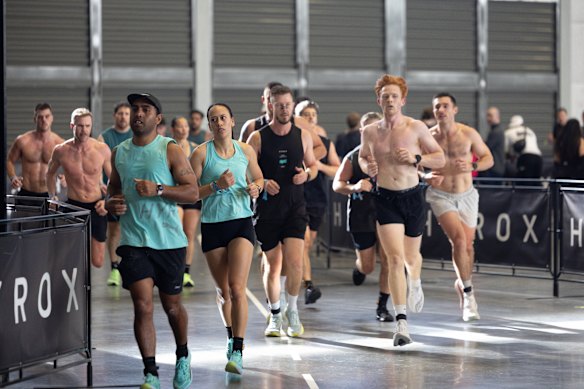 People compete at the biggest HYROX event ever held in Australia.Sitthixay Ditthavong
Three years ago, when HYROX first launched here, 1348 people turned up in Sydney. Last week, a record number – nearly 30,000 participants – competed over five days inside the domed ceilings of Sydney Showground.
Waves of people, large and small, smiling and (mostly) suffering between the ages of 16 and 75 ran eight laps of the one-kilometre indoor course. Each lap is broken up by a different functional activity – burpees, lunges, farmer’s carry, SkiErg, rowing, pushing, pulling and wall balls.
With sweat dripping, crowds cheering and judges crouched inches away from competitors’ nether regions to check their technique, the sport is an acquired taste that people are clearly building an appetite for.
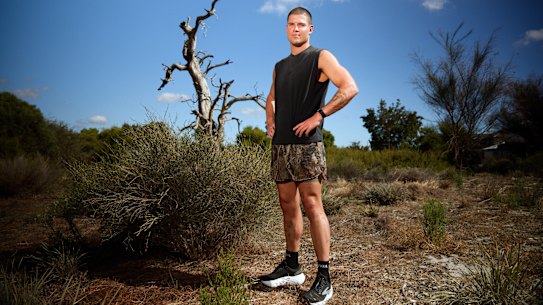
Jon Wynn, who lives on the Gold Coast, first learnt about the sport while living in Spain’s Majorca, in recovery from addiction.
During four back-to-back tours of Afghanistan, where he served as a commando with the Special Forces, he had been shot in the back, and developed PTSD. Readjusting to civilian life each time became increasingly difficult, and Wynn began self-medicating with drugs and alcohol.
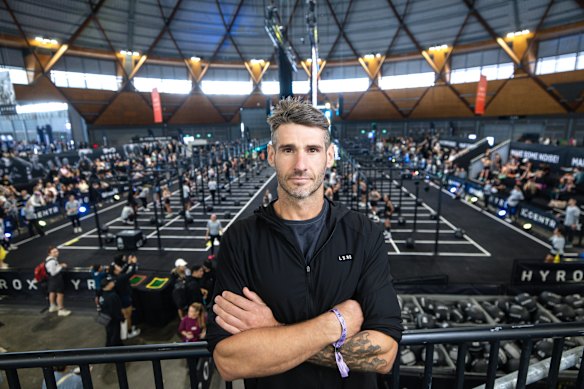 Finding purpose and hope through HYROX: Jon Wynn.Sitthixay Ditthavong
Within three months of failing a drug test and being discharged from the military in 2013, he was back in Afghanistan as a contractor.
But his life was falling apart. Suicidal, sectioned for psychiatric treatment and, by this stage, heavily dependent on drugs and alcohol, Wynn ended up in and out of rehab 15 times.
“I hit many rock bottoms,” he says.
The final time, he was stuck in Spain during COVID: “I spiralled out of control … It was really, really scary. I just lost my mind and I surrendered.”
After another stint in rehab, he began working with an addiction therapist. He also turned to fitness.
As a kid, growing up in a small town on the Mid North Coast of NSW, sport had helped him to deal with the bullying he received for being overweight and with stresses at home.
Related Article
“Fitness has always been an anchor for me,” says Wynn, now 39.
Before tearing the ligament off his elbow bone at 16, he had been on the Australian world youth team as a javelin thrower. After a brief foray into football, where he didn’t quite make the cut to go pro, he had found the military.
During lockdown in Spain, he swung kettlebells and skipped with a rope. And when the gyms reopened, he began working out there – which is where he saw a poster for HYROX.
This new sport, developed in Germany in 2017, looked hard. But his experiences in the military and overcoming addiction made him suspect that he could handle “hard”.
“The addict can be good at sport because they can sit in suffering, they can sit in their own discomfort and pain,” says Wynn, who now runs his own performance coaching business. “They’ve experienced that for a long time.”
When it really starts to hurt, he tells himself: “I’ve done harder things than this. It’s a 60-minute race.”
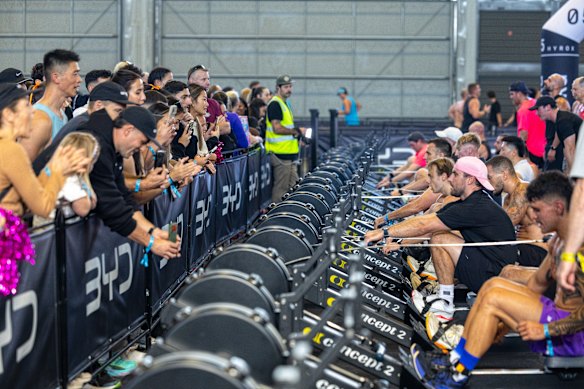 HYROX in Sydney.Sitthixay Ditthavong
But HYROX went beyond suffering – it gave him purpose, discipline and something to turn up to and strive for. It gave him hope.
Now a father of two, Wynn has just returned from Stockholm where he was part of the Australian mixed relay team that won the World Championships.
This year, coming into his fifth season as a HYROX athlete, his training involves up to 20 hours a week, including some 90 kilometres of running, as well as two strength sessions and three sport-specific sessions.
 People compete at the biggest HYROX event ever held in AustraliaSitthixay Ditthavong
Participation does not require that level of dedication, and athletes have come from backgrounds as varied as running, triathlons, body building, tennis and swimming.
That is because the sport was designed to provide a sense of purpose to the training of anyone who goes to the gym. This is its appeal, says Lock.
Related Article
“Rather than going to the gym on their own with the headphones on, now they actually train with friends, family, colleagues, towards a common goal,” Lock says.
He believes the growth of the sport owes to its “ripple effect” in the community.
“Most people have trained for months to cross that finish line and that normally has a positive impact on their lives,” Lock says. “Maybe they’re getting fitter, or maybe their mental health has improved. These are the ripple effects on them and on the other people in their lives.”
And whether a competitor suffers, celebrates or does both, completing a hard challenge is revealing.
“We can tap into way more than we think we can.”
Make the most of your health, relationships, fitness and nutrition with our Live Well newsletter. Get it in your inbox every Monday.
Save
You have reached your maximum number of saved items.
Remove items from your saved list to add more.
 Sarah Berry is a lifestyle and health writer at The Sydney Morning Herald and The Age.Connect via X or email.