
A coastal council in Victoria’s south-east is calling for the federal government to make big polluters pay for climate-related damages.
The Bass Coast Shire Council will write to Climate and Energy Minister Chris Bowen asking for the government to impose a levy on fossil fuel companies, with the funds raised to help communities recover from extreme weather events.
A Climate Council report released this year found annual disaster costs per Australian had increased by 200 per cent since the 1980s.
State and federal governments have poured $9 million into protecting coastal towns in Bass Coast.
Mat Morgan wants major polluters to help pay for recovery from climate-related disasters. (Supplied: Greens/Mat Morgan)
Councillor Mat Morgan, a Greens candidate at the upcoming Victorian election, put the motion to council at a meeting last month.
Councillors voted to approve the motion, five votes to four.
“We give away the majority of our gas for free, and we’re exporting it overseas,” Cr Morgan said.
“Australians should be getting a fair share of the returns from the resources that belong to us, and we should use that money to pay for climate damage.”
Community hit by erosion
Victoria’s Bass Coast has been affected by worsening storms and coastal erosion for more than a decade.
In the tourist town of Inverloch, more than 70 metres of foreshore at the surf beach has been lost to erosion since 2012.
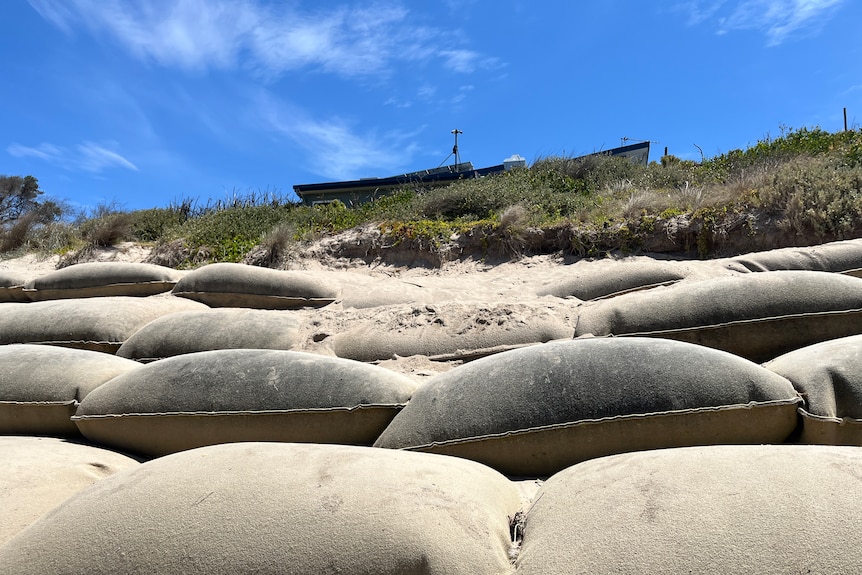
Inverloch is yet to have a permanent solution to coastal erosion. (ABC Gippsland: Danielle Kutchel)
Inverloch’s surf lifesaving club was built in 2010 and, due to erosion, is now protected from incoming tides by sandbags.
Measures such as wet sand walls have helped to protect the town’s shoreline, and a dredger is now used to move sand from a nearby inlet to the surf beach.
“We’ve got kilometres and kilometres of coast. So much of our housing [is] built on coastal communities that we are walking into an absolutely existential crisis for some of these regional towns and councils,” Cr Morgan said.
“We’re very happy to leave the finer details up to [Chris Bowen], but we’re joining a chorus of local governments that are saying that the status quo is not good enough.”
Shorelines receding
In the town of Silverleaves on Phillip Island, also part of the Bass Coast Shire, the western shoreline has receded 77m due to erosion.
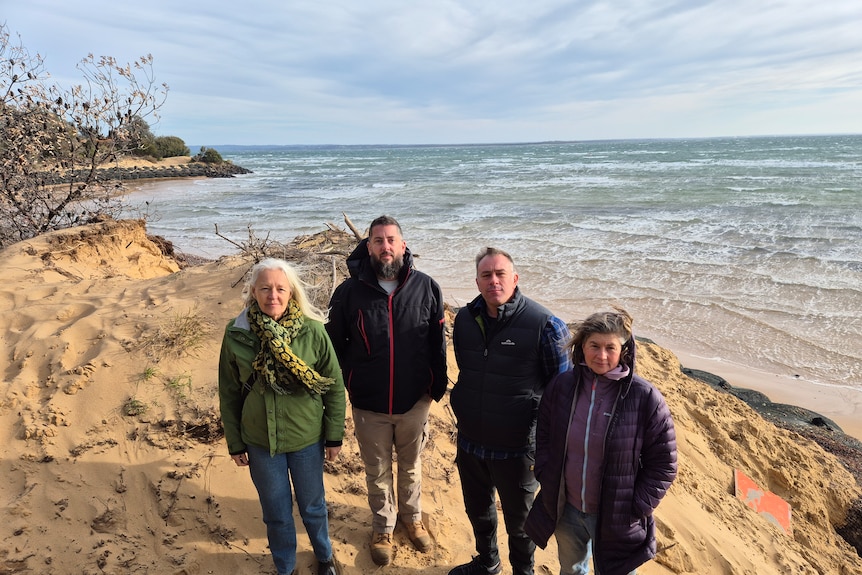
A rock bag wall is designed to protect the homes of residents in Silverleaves. (ABC Gippsland: Danielle Kutchel)
“These aren’t hypothetical matters for us in Bass Coast. It’s either we pay for it and our ratepayers pay for the damage or the fossil fuel polluters do,” Cr Morgan said.
Local retired science teacher Aileen Vening has documented and witnessed the erosion.
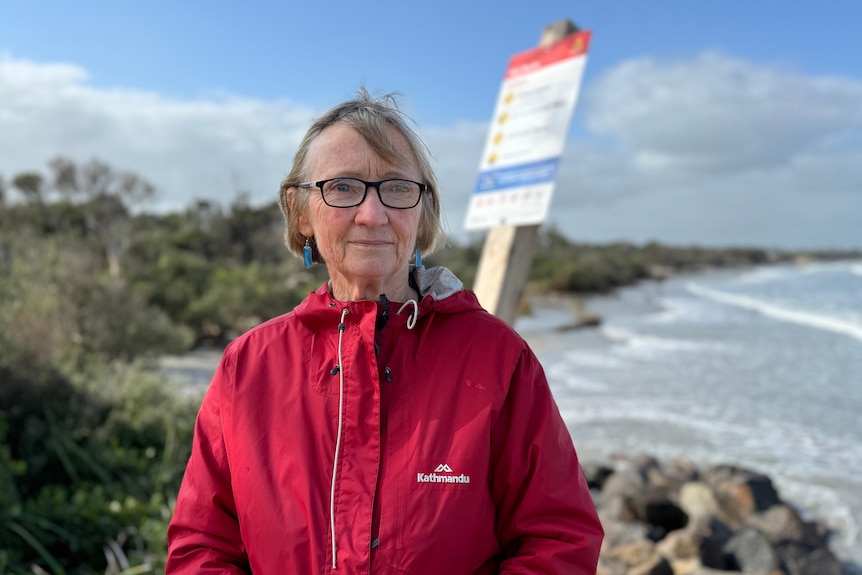
Aileen Vening says she is seeing the impact of erosion. (ABC News: William Howard)
“If you want a reality check about the way things are going with climate change, then just look at Inverloch,” Ms Vening said.
“The connection between what is happening here and the stuff we are digging out of the ground and pumping out and the pollution that’s being caused, there’s a direct connection, and they have to be held to account.”
She said she was disappointed by indications from the federal government that it would not impose a 25 per cent tax on gas exports.
“There needs to be more acknowledgement of the dire situation we are in with our climate,” she said.
Levy would be ‘only fair’
The Australia Institute senior economist Jack Thrower said councils were picking up the tab for the impacts of climate change, but their budgets could not keep up.
“Someone is going to need to pay for the costs of climate change, and at the moment, it is being picked up by taxpayers and ratepayers while these fossil fuel companies make huge profits,” he said.
“Companies based in Australia have contributed significantly to the climate crisis, and it’s only fair for them to have to pay for some of those costs.
“It’s more equitable and just that it’s paid by these companies than by households and communities.”

Jack Thrower says fossil fuel companies should pay for their contribution to climate change. (Supplied: The Australia Institute)
He said the scale of the effects of climate change on Australia was “huge”, with disasters increasing in severity and frequency.
There are other, more subtle costs, too, he said, such as hotter days impacting education and physical health.
The Australia Institute has previously proposed a levy on fossil fuel exports that could raise up to $100 billion a year.
Mr Thrower said this money could support efforts to address the impacts of climate change while lowering exports and emissions.
Government highlights existing support
The federal government did not directly address questions about whether it would support a levy on big polluters.
A spokesperson for Assistant Climate Change and Energy Minister Josh Wilson said the government’s transition away from fossil fuels was working.
“Over 20 gigawatts of renewable energy have been added to the National Energy Market since 2022 [when the government was elected],” the spokesperson said.
“We are also investing $1 billion as part of the Disaster Ready Fund, where the Australian government partners with state, territories, and local governments to help communities build resilience to worsening natural disasters.”
The ABC contacted Australian Energy Producers and the Australian Energy Council, which represent some of Australia’s largest fossil fuel companies, for a response.